

Why the brands that truly see their digital shelf are the ones that grow
If you sell online, there is only one reality that ultimately matters: what the consumer actually sees.
Not what your PIM says.
Not what your DAM stores.
Not what retailers report.
And not what dashboards assume.
But what the consumer actually sees when they search for your product. Or for your competitor’s. In the end, that is the reality that determines whether someone clicks buy, or not.
I call this the Consumer Reality Layer.
It’s a simple idea. But once you start looking at your digital shelf this way, you realise how often this layer is missing.
What the Consumer Reality Layer actually is
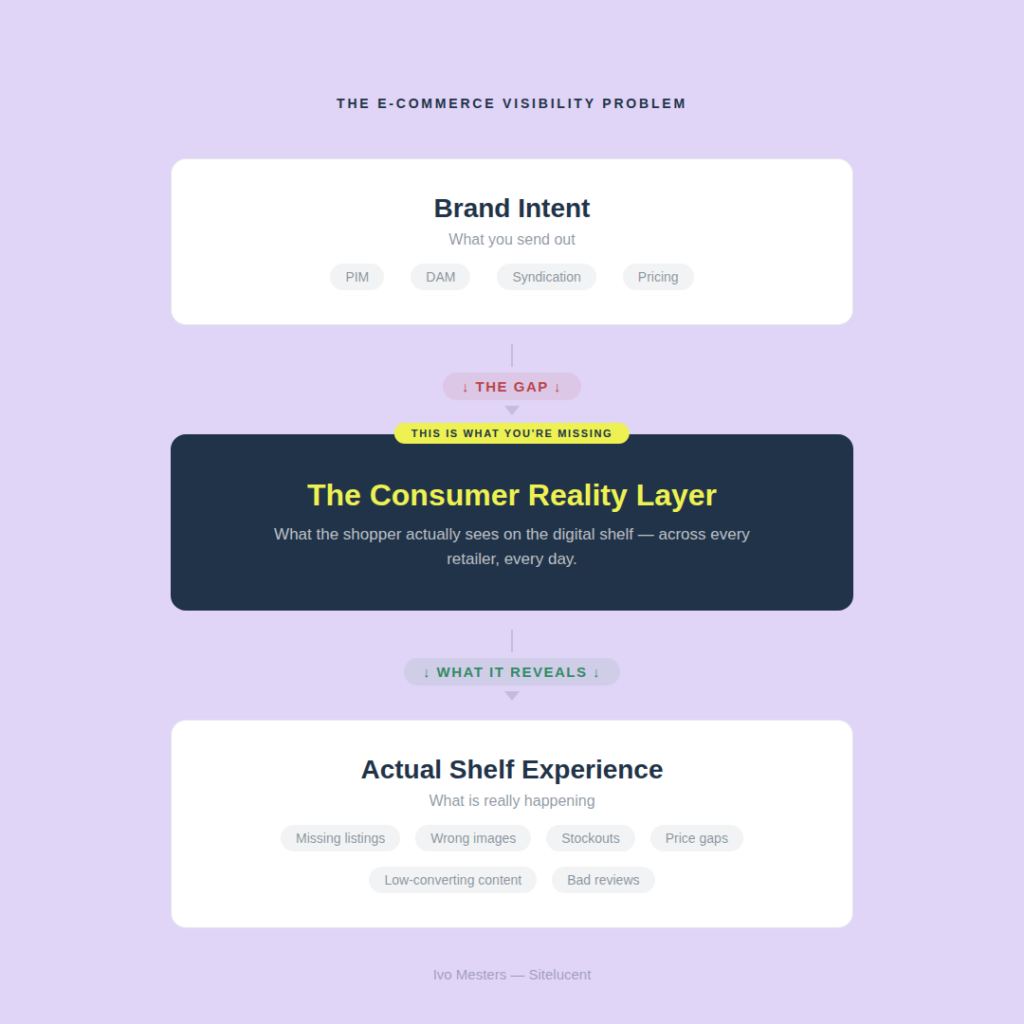
Most organisations manage their e-commerce through internal systems and retailer data.
They have product information in a PIM. Digital assets in a DAM. Content distributed through syndication. Retailer dashboards and reports. All valuable.
But these systems mainly show what should be happening. The Consumer Reality Layer shows what actually happens. It looks at the digital shelf exactly the way a consumer does. When someone searches for your product. When they land on a product page. When they compare you to a competitor. At that moment several questions become very clear:
Is your product actually visible?
Is it in stock?
Is the content complete and convincing?
Is the price competitive?
Are the reviews helping or hurting you?
This is where visibility, presence and performance become real.
Why it matters
Without the Consumer Reality Layer, e-commerce performance often remains partly accidental. Products disappear from listings. Stock runs out. Buy Boxes shift.
Content degrades. Search visibility drops. Often quietly. And often without anyone noticing immediately.
By the time teams discover the issue, days or weeks may have passed. Revenue has already leaked away. The Consumer Reality Layer prevents that. When you continuously see what the consumer actually sees, you can intervene immediately.
But it does something even more important.
It makes optimisation possible. Sructurally. You can improve visibility. Strengthen your presence. Increase your conversion. In other words: you stop reacting to problems, and start deliberately improving performance.
Why most brands still miss it
Manaully checking product pages simply does not scale. A brand may have hundreds or thousands of SKUs. Across dozens of retailers and marketplaces. Monitoring all of that by hand, day after day, is simply impossible. So most companies check a few products occasionally. Which means the majority of their digital shelf remains largely invisible.
Why this becomes the foundation of e-commerce growth
E-commerce is maturing. Competition is increasing. Margins are under pressure. And the digital shelf is becoming more complex every year. As a result, growth is less about launching more products or running more promotions. It’s about continuously improving what is already there. The brands that succeed structurally do three things very well:
They ensure they are visible.
They ensure they stand out.
They ensure they convert.
Visibility.
Presence.
Performance.
But that kind of optimisation only works when you can actually see what is happening. That is what the Consumer Reality Layer provides. It allows you to detect problems early. Prevent revenue leakage. And continuously optimise your digital shelf. So growth is no longer based on lucky shots. It becomes data-driven. Not just preventing lost revenue. But also actively creating new revenue.
Because when you truly see what the consumer sees, you gain the ability to improve it. And that is where real e-commerce growth starts. If you sell online and you have growth targets for your digital shelf, one question becomes unavoidable: do you actually see the Consumer Reality Layer of your business?
Ivo Mesters, CEO Sitelucent.
Or reach out anytime.
ivo.mesters@sitelucent.com | LinkedIn