
If you’re honest, the answer is probably: not entirely. And you’re not alone. This blog is about the gap between what brands think is happening on their digital shelf and what’s actually happening , and how closing that gap directly translates into revenue.
Before brands start working with digital shelf analytics, the questions they ask are remarkably similar. Not because they lack sophistication, but because the challenge is universal.
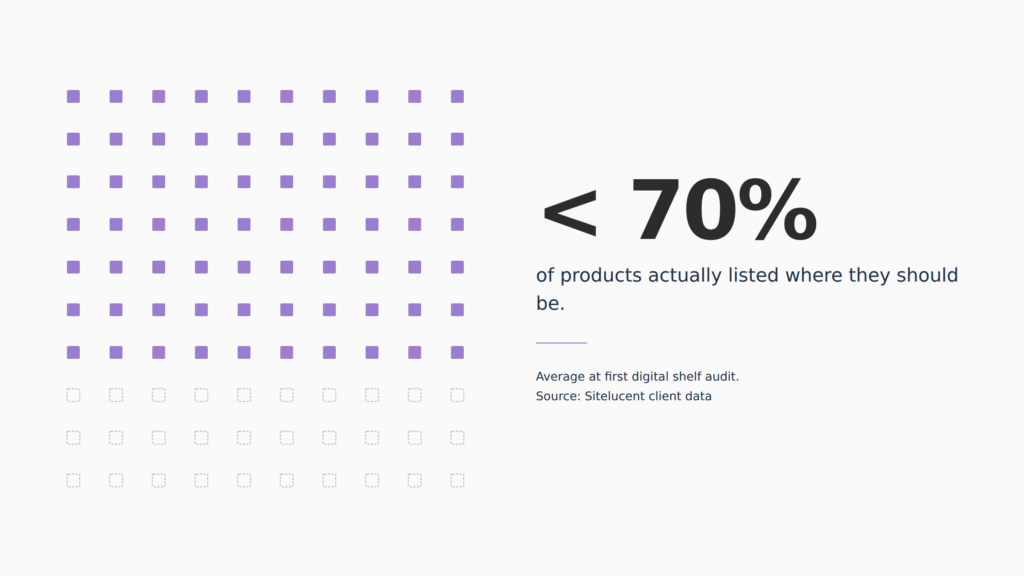
Are all my products actually listed where they should be? Most brands assume that once a product is set up with a retailer, it stays live. The reality: listings disappear, get deactivated, or are never properly activated in the first place. In our experience, roughly 80% of brands that check for the first time discover their listing completeness is below 70%. Online out-of-stock rates average around 15%, nearly double the rate in physical retail. One client discovered €1.5 million per month in lost sales from this layer alone. That’s not a marginal issue. It’s structural revenue loss hiding in plain sight.
Is my content complete and correct on every retailer? You approved the product page. But what actually shows up on the retailer’s site? Wrong images, missing bullet points, outdated descriptions, it happens constantly. And it matters: 75% of consumers form a negative opinion about a brand when they encounter incomplete product information online. Content isn’t cosmetic. It’s conversion.
Are my prices consistent and within the agreed corridors? You set a recommended selling price and a minimum promo price. But are your retailers respecting those? Are third-party sellers undercutting? Is someone violating your pricing strategy on a marketplace you’re not even monitoring? Research from Harvard Business Review found that unauthorised retailers violate pricing policies around 50% of the time. You don’t see it if you don’t look.
Where do I rank compared to competitors? You have a great product. But can the consumer find it? Moving from page 2 to page 1 in search results can increase sales by 40%. A top-5 position can boost sales by up to 89%. Search ranking on retailer websites is becoming the equivalent of shelf positioning in a supermarket, except it changes every day. Without monitoring, you’re playing a game without knowing the score.
What are customers saying in reviews, and how does it compare? Reviews directly influence purchase decisions and search ranking. But monitoring reviews across 30+ retailers, in multiple languages, for hundreds of SKUs? That’s not something you do in a spreadsheet.
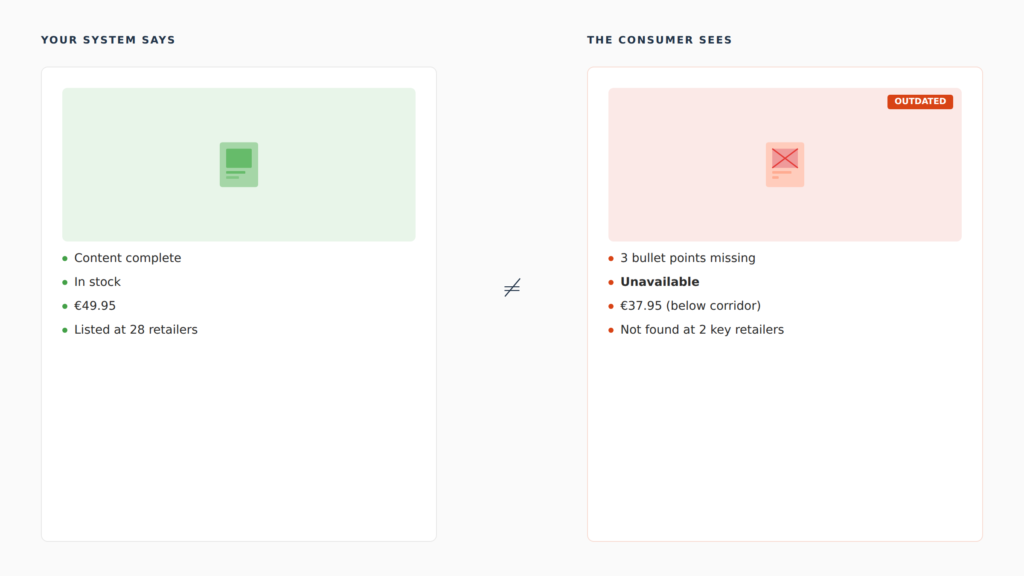
Here’s the fundamental problem: most brands manage their digital shelf from the inside out. They look at their PIM, their ERP, their retailer portals, their internal dashboards. And those systems say everything is fine.
But the consumer doesn’t see your PIM. The consumer sees a product page. And on that product page, the reality is often different from what your internal data suggests.
Your ERP says “in stock.” The product page says “unavailable.” Your PIM says the content is complete. But on the product page at retailer X, half of it is missing. Your brand guidelines prescribe a specific hero image. But on three out of ten channels, there’s an outdated photo.
This gap between the internal truth and the external reality, the consumer’s view, is where revenue leaks. Silent erosion that nobody sees, unless you deliberately look through the consumer’s eyes.
Retailer reports don’t solve this either. They show sell-through data, not shelf quality. They tell you what happened, not what’s happening right now. And they definitely don’t tell you how your product page compares to your competitor’s, on the same retailer, at the same moment.
The reaction is almost always the same. Surprise! When brands start monitoring their digital shelf through the consumer’s eyes for the first time, they discover things they didn’t know were happening. And the impact is often bigger than expected.
One global consumer electronics brand discovered €1.5 million per month in revenue leakage. Not from pricing issues or marketing underperformance, just from the basics: missing listings and products out of stock at key retailers. Nobody was looking at the shelf through the consumer’s eyes. The products simply weren’t there.
A beauty brand in the Benelux was spending hours every week manually checking retailer websites. Despite the effort, stockouts went undetected, content inconsistencies persisted, and there was no structural visibility across channels. Once they started using automated digital shelf monitoring, listings gaps were detected in real time, hours of manual work were eliminated, and content was structurally optimised. Their Senior Business Analyst put it simply: “We all have one version of the truth now.”
A European healthcare brand was managing pricing corridors across multiple countries and currencies, manually. The real problem wasn’t knowing when a price dropped. It was understanding why. With automated monitoring, price deviations are now analysed alongside availability, content, and competitive data, giving them context instead of just alerts. The result: stronger retailer negotiations and promotional ROI they can actually measure.
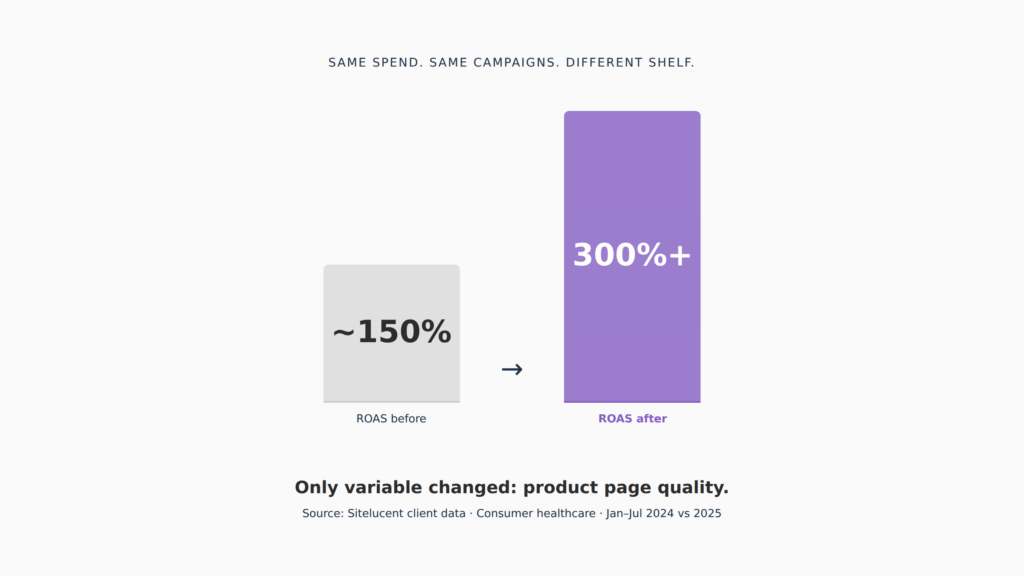
An international consumer healthcare company was investing in retail media across multiple European markets. The campaigns were running, the budget was allocated. But the question nobody was asking: are the product pages those campaigns land on actually ready to convert? By using digital shelf analytics to structurally optimise content completeness and quality across retailers, one of their brands saw ROAS more than double, from approximately 150% to over 300%, with comparable media spend. Same campaigns. Same budget. The difference was the quality of the shelf underneath.
What’s telling is the pattern that follows. Brands typically start monitoring in one country. They see the value, start optimising, and see results. Then Germany asks: “What tool is that?” France wants access. The UK sees the dashboards. The platform scales, the insights translate, and the business case is already proven by their own team. We see this pattern accelerating: more and more brands are scaling from one or two countries to European and even global level. One client started in a single market and now runs the platform globally (and yes, of course it’s time for headquarters to pick this up from day one, not wait until country teams have proven the case individually).
Let’s be blunt: you cannot manually monitor a digital shelf in 2026. Do the maths. A mid-sized brand with 500 products sold across 30 retailers faces 15,000 product pages. At two minutes per page, that’s 500 hours per check. And things change daily, Amazon alone adjusts prices millions of times per day. You’re not monitoring. You’re sampling. You’re guessing.
Gartner, in their Market Guide for Digital Shelf Analytics, states it explicitly: as digital commerce channels continue to diversify, manual measurement and auditing is simply no longer feasible. They recommend brands evaluate automated solutions against the cost and accuracy of manual processes.
This isn’t a nice-to-have for large enterprises only. Any brand selling through online retailers, whether you have 20SKUs, 100 or 10,000, faces the same fundamental challenge: you don’t control those shelves, but you are responsible for what happens on them.
The digital shelf is no longer a side channel. It’s the primary battleground for brand revenue. European e-commerce reached €842 billion in 2024, with marketplaces accounting for 70% of cross-border online trade. Forrester projects that e-commerce will drive half of all retail sales growth in Western Europe through 2030. And research consistently shows that the majority of in-store purchases are now influenced by online research, with recent European data putting that figure at over 70%.
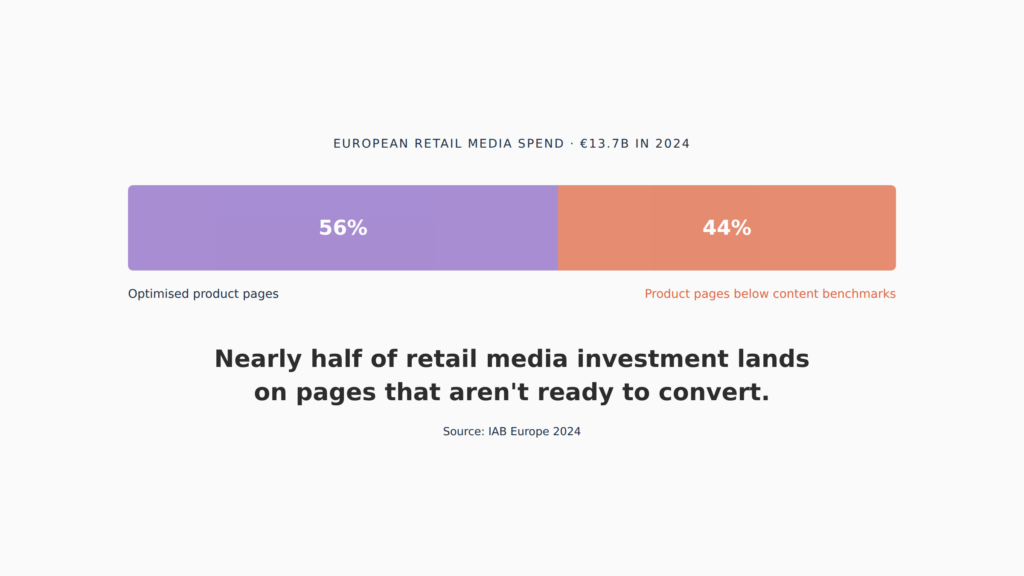
At the same time, retail media, paid advertising on retailer websites, has become the fastest-growing ad channel globally, projected to surpass TV advertising this year. In Europe alone, retail media spend reached €13.7 billion in 2024, growing over 21% year-on-year. Brands are investing heavily to drive traffic to their product pages.
But here’s the disconnect: research shows that 44% of retail media campaigns send shoppers to product pages that don’t meet basic content benchmarks. Nearly half of that growing investment is partially wasted, because the shelf isn’t ready for the traffic.
The conclusion is straightforward. You can’t afford to invest in driving traffic to product pages you’re not monitoring. And you can’t afford not to monitor them, given what’s at stake.
Digital shelf analytics gives you an automated, real-time view of how your products appear across all your online retailers, through the eyes of the consumer. Not once a month. Every day.
Listings & availability: Are your products actually there? Are they in stock? Are they activated everywhere they should be? You get instant alerts when something drops off, not after a week of lost sales, but the moment it happens.
Content: Is your product content complete, correct, and consistent across every channel? Are the right images showing? Are descriptions and specifications matching your brand guidelines? You see where the gaps are and what to fix first.
Pricing: Are your pricing corridors respected? Who’s undercutting? Where are third-party sellers creating problems? You don’t just see that a price dropped, you see it in context of availability, content, and competitive positioning.
Visibility & search: Where do you rank for the keywords that matter? Who’s above you? Are your sponsored positions actually being captured? Share of Search is becoming the leading indicator for online market share.
Reviews & ratings: What are consumers saying across channels? How do your ratings compare to competitors? Where do you need to act?
The platform doesn’t just show you data. It shows you where to act first. That’s the shift from monitoring to managing, and from managing to growing.
1. Calculate your ROI. Our ROI calculator lets you input your SKUs, channels, and average selling price, and see what digital shelf analytics would deliver for your brand. No sales call required. Most brands see a positive return within weeks, not months.
2. See your own data. We can show you a demo with your own products, on your own retailers. Reach out to Willem directly

Do you want to talk about your digital shelf and your challenges? Book a Discovery Call.