
PHOTO BY IKEA WEBSITE ILLUSTRATION WARREN ESPEJO
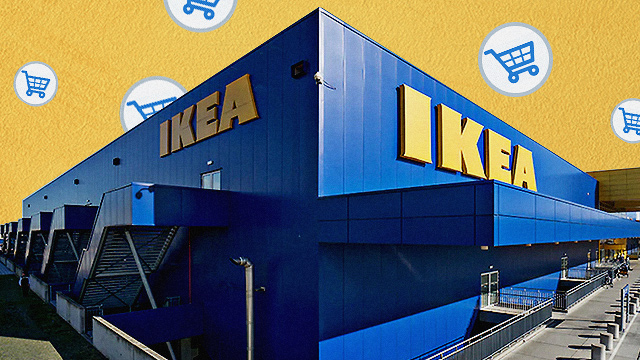
If there’s one retailer built on the physical experience, it’s IKEA. The winding route through the showroom, the fabric you touch, the meatballs at the end. And yet the most telling number in home & living right now comes from exactly that company. According to Twinkle, a third of IKEA Netherlands’ revenue, 33 percent of 1.66 billion euros, came from online sales in its latest financial year, up from 31.9 percent the year before. Online visits grew 6.2 percent, faster than the 4.1 percent growth in store visits.
Let that sink in. At the archetype of the showroom, one in every three euros is now spent on a screen, and the gap is widening in favour of online. This is not a company hedging its bets either: parent organisation Ingka announced an investment of 3 billion euros to convert its stores into mini distribution centres, built specifically for e-commerce. The showroom itself is becoming online infrastructure.
In some categories, online mainly does the orientation and the store closes the sale. Home & living has moved past that point. Yes, the journey still starts on a screen: inspiration on Pinterest and Instagram, comparison across webshops, checking dimensions and materials at the kitchen table. But increasingly, the purchase happens right there too. The consumer who measured their living room on Tuesday evening orders the cabinet on Tuesday evening.
That makes the digital shelf in this category two things at once: the front door to every sale, and more and more often the checkout itself. Whoever wins the screen wins twice.
Here’s the part that matters if you’re a brand. IKEA controls its own shelf, physical and digital. Your furniture, lighting and home accessories live on shelves that belong to someone else: bol, Amazon, wehkamp, fonQ, and the webshops of home retailers across Europe. And in this category, the product page has to work harder than almost anywhere else. Nobody can sit on your sofa online. The image is the product. The dimensions are the fitting room. The reviews are the shop assistant.
The stakes are real. When Harman, the home of JBL, started looking at its shelf through the consumer’s eyes, it uncovered 1.5 million euros in monthly revenue leakage, from listings and availability alone, on its key accounts. Nothing exotic. Just products missing or out of stock while internal reports showed green.
So turn it around. This is not a threat, it’s a to-do list, and every item on it is within your control.
Make sure you’re listed, on every retailer and platform that matters. Make sure you’re in stock, because a living room project doesn’t wait for a restock. Make sure your content and visuals are flawless: complete dimensions, correct materials, images that let the consumer place the product in their own home. Make sure your reviews work for you. And make sure you’re visible in retailer search, preferably on page 1, because that’s where the comparison happens.
You can only manage this if you can see it, the way the consumer sees it, on every retailer, every day. That outside-in view is exactly what digital shelf analytics provides: one daily picture of your listings, availability, content, prices, reviews and search visibility, next to your competition.
This is where digital shelf analytics and optimisation, certainly with Parker, Sitelucent’s AI assistant, makes the difference. It ensures you perform at your best on that shelf: easy to find, easy to choose. You know exactly where you stand against your competitors, including the ones you didn’t even know you had, and you get every handle you need to rise above them. Sitelucent enables you to stand out, and from there to genuinely drive revenue.
A third of the category leader’s revenue is already online, and the rest of the journey starts there. Take control of your online shelf, and drive revenue.
Sitelucent. What stands out, sells.