
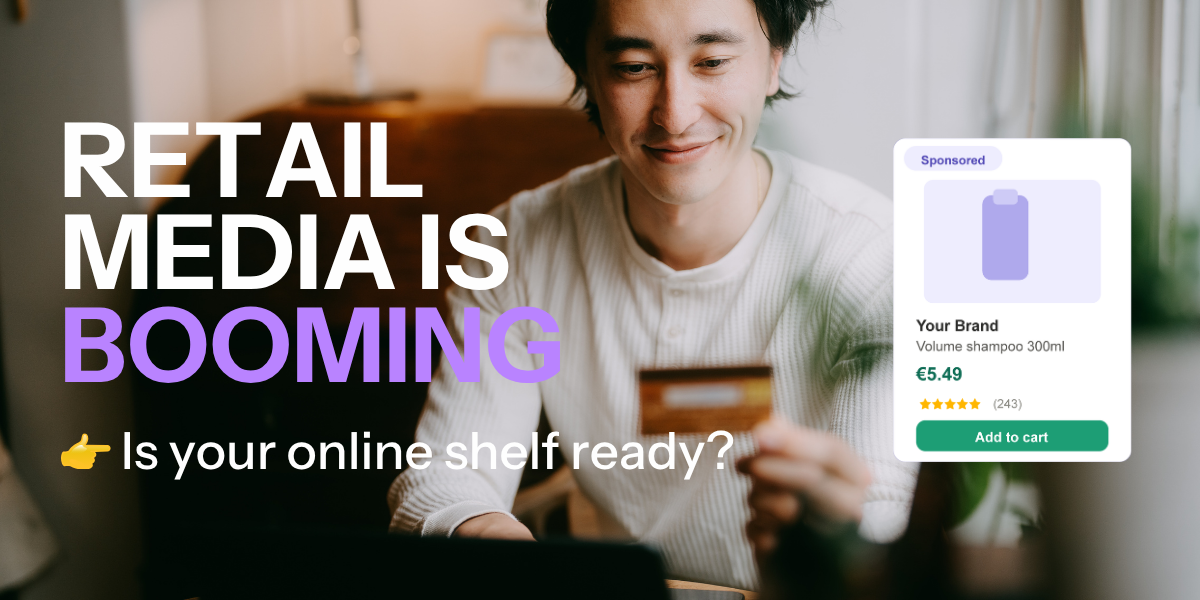
Retail media is projected to reach $203.9 billion globally in 2026. Brands are spending more than ever on sponsored placements and display ads across retailer platforms. But here’s the uncomfortable question: do you actually know what that spend is delivering?
The measurement gap
The appeal of retail media is obvious. Retailers sit on first-party purchase data. The ad is served at the point of sale. Attribution should be straightforward. Except it isn’t. 😬
Most retailer platforms report ROAS in isolation: per campaign, per format, per placement. What they don’t tell you is how the combination of different media types performs together. And unlike Amazon, which tracks repeat purchases and customer lifetime value back to the original ad, most European retailers still measure a single transaction. One ad, one purchase, one ROAS number. That’s it.
The result? Brands are making budget decisions on incomplete data. And in a market where retail media is growing 14% year-on-year, that’s a significant blind spot.
The foundation problem nobody talks about
Here’s what gets overlooked in most retail media conversations: your ad spend is only as good as the shelf it lands on. Think about it. You invest in a sponsored placement that pushes your product to the top of search results. A consumer clicks. And then what? If the product page has incomplete content, the wrong image, or inconsistent pricing, that click doesn’t convert. Worse: if the product is out of stock at that retailer entirely, you’ve just paid for a dead end.
This is where retail media strategy and Digital Shelf Analytics intersect. And it’s a connection that most brands haven’t made yet.
Before you optimise your retail media spend, you need to know the state of the shelf you’re advertising on. Are your products actually listed where you think they are? Is the content correct and complete? Is the price consistent with your strategy? Are you in stock?
If the answer to any of those questions is “I’m not sure”, you have a retail media problem that no amount of bidding optimisation will fix.
ROAS is necessary. But it’s not sufficient.
The industry is starting to recognise that ROAS alone tells an incomplete story. Yes, it’s the primary KPI for product ads. But as retailers expand into display formats, video, and in-app placements, the conversation is shifting towards brand awareness and incrementality.
Incrementally, measuring how much extra revenue your ads generate beyond what you would have sold anyway, requires holdout groups and close collaboration with the retailer. That’s complex. And it’s only meaningful if you have a baseline understanding of your organic performance.
This is exactly what Digital Shelf Analytics provides: the baseline. How visible are you in organic search results? What’s your share of search versus competitors? Where are you losing positions and to whom?
Without that baseline, you can’t separate what retail media is driving from what your organic shelf presence is already delivering. You’re measuring in the dark.
Share of Search: the metric that connects everything
Share of Search is emerging as the single most important metric for online market share. It tells you what percentage of search results in your category belong to your brand, across organic and sponsored positions.
The brands that monitor this daily see something others miss: the competitive dynamics behind their numbers. A drop in organic Share of Search might mean a competitor increased their sponsored spend. An increase might mean your content optimisation is paying off. Either way, you can’t know without looking.
And crucially: Share of Search connects your retail media investment to your broader commercial strategy. If you’re spending on sponsored placements but your organic visibility is declining, you’re renting positions instead of owning them. That’s a strategic choice you should make deliberately, not one you discover after the budget is spent.
AI is changing the game. Your data needs to keep up.
Mature retail media networks are now using AI-driven bidding for 75% or more of their ad spend. Algorithms adjust bids in real time based on conversion probability, product margins, and competitive intensity. But here’s the catch: AI is only as good as the data it works with. If your product data is inconsistent across retailers, if listings are missing, if content quality varies — the algorithm can’t compensate for that.
And this goes beyond retail media. As AI agents start making purchase recommendations on behalf of consumers, the quality and completeness of your product data becomes the deciding factor in whether you even enter the consideration set.
The brands that treat their product data as a strategic asset — monitoring it daily, fixing issues proactively, and optimising systematically, are the ones that will get the most out of both retail media and the AI-driven commerce that’s coming next.
The bottom line
Retail media isn’t just a media question. It’s a shelf question. Before you increase your retail media budget, look at the foundation it’s built on. Monitor your listings, availability, content, pricing, and search visibility across every retailer, every day. Understand your organic baseline. Then — and only then — can you measure what your retail media spend is truly delivering.
Because the brands that win in 2026 won’t just be the ones that spend the most on retail media. They’ll be the ones that know exactly what their shelf looks like before, during, and after every campaign.
What stands out, sells. But first, it needs to be visible.
Sitelucent monitors the digital shelf across 1,000+ retailers globally, giving brands the foundation they need to make retail media measurable. Curious what your shelf looks like right now?

And if you want to see your own shelf through the consumer’s eyes, book a discovery call with Willem, he’ll walk you through your own data.