

It’s the most compared category in retail, and the one where the digital shelf decides the most. Here’s how the brands winning it think about it.
Consumer electronics was the first category to move online at scale, and it’s still the furthest ahead. The global market is worth well over a trillion dollars, and around one in three of those electronics euros is now spent online. In the United States, the online share of the category has already passed half.
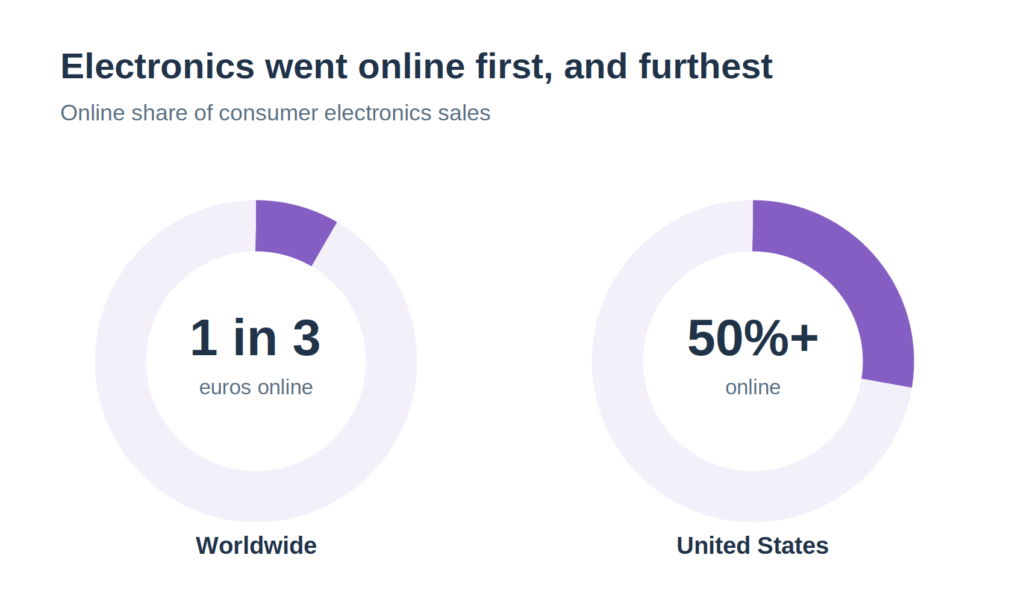
That’s worth sitting with for a moment. For an electronics brand, the shelf that decides whether a product sells is, more and more, a screen. And the brands doing well are the ones giving that screen the same attention they once gave the retail floor. Let’s walk through why this category is different, and what taking control actually looks like.
Your buyer decides on the digital shelf, before you ever see the sale
Electronics buyers research before they commit, and they research thoroughly. Around 72 percent begin their search online, the highest of any retail category. Before buying a single device, a typical shopper:
→ Visits four or more retailer sites
→ Compares specifications across all of them
→ Reads reviews, as 97 percent of buyers do before deciding
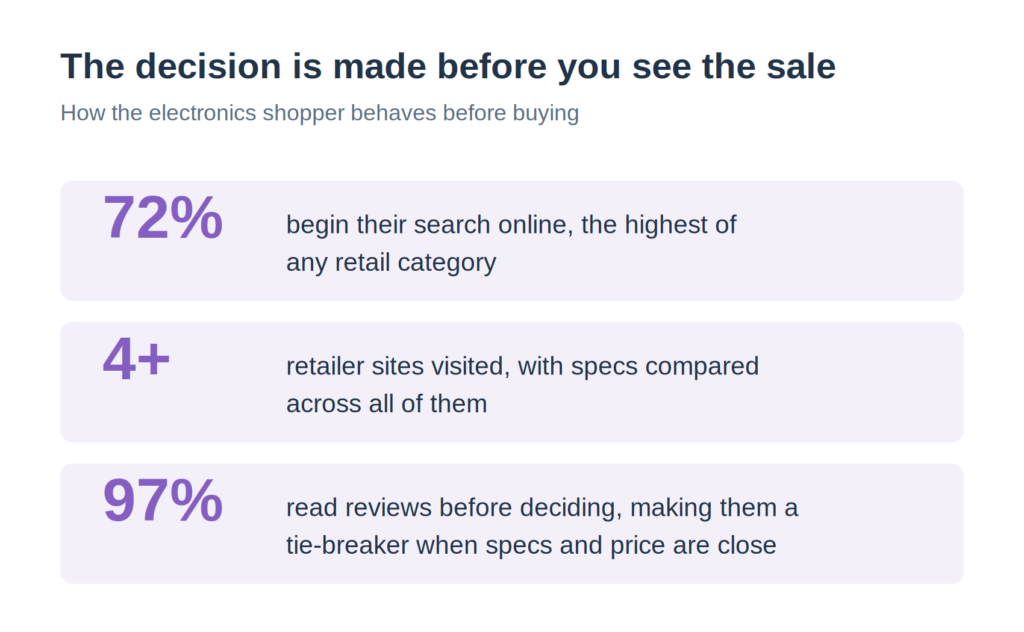
So the real decision happens on the digital shelf, well before it ever shows up in a sales report. Every one of those comparison points is a small moment where the sale is either earned or quietly lost.
And the margin for error is thin. Around 55 percent of consumers won’t complete a purchase when a product page is incomplete or incorrect. In a category built on specifications, a missing or wrong detail isn’t cosmetic. It’s the reason someone clicks away to a competitor. The effect outlasts the single sale, too: roughly 87 percent of consumers say they’re unlikely to return to a brand after finding product information that turned out to be wrong.
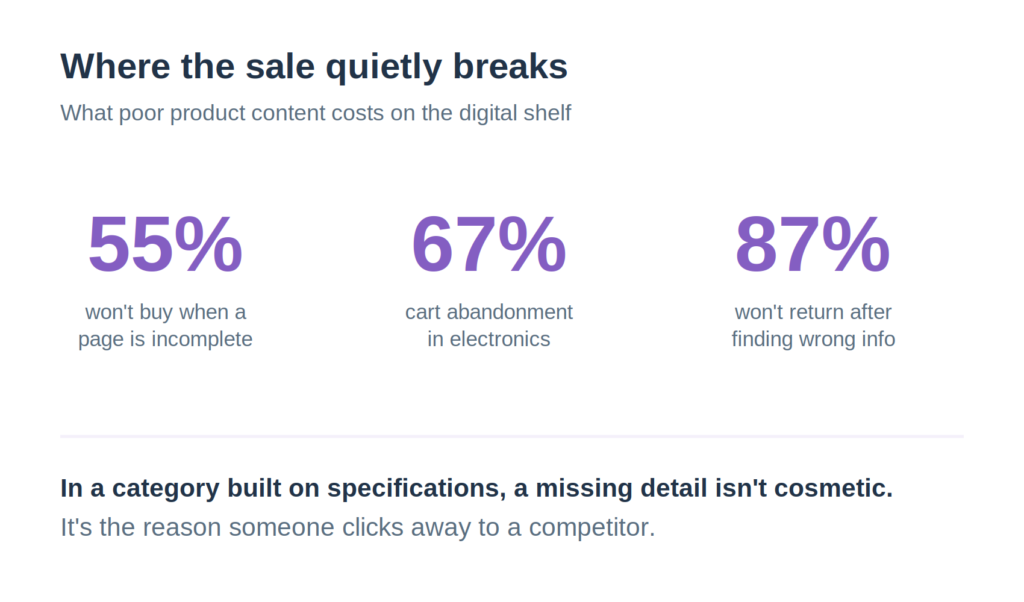
None of this is a content nicety. For electronics, accurate and complete listings are simply where conversion begins.
It starts with the basics: is your product even there?
Before content, before pricing, before anything clever, there’s a simpler question that trips up more brands than you’d expect: is your product actually listed, and actually in stock, everywhere it should be?
It sounds almost too basic to matter. It isn’t. This is where nearly every brand finds its first win, and often its biggest.
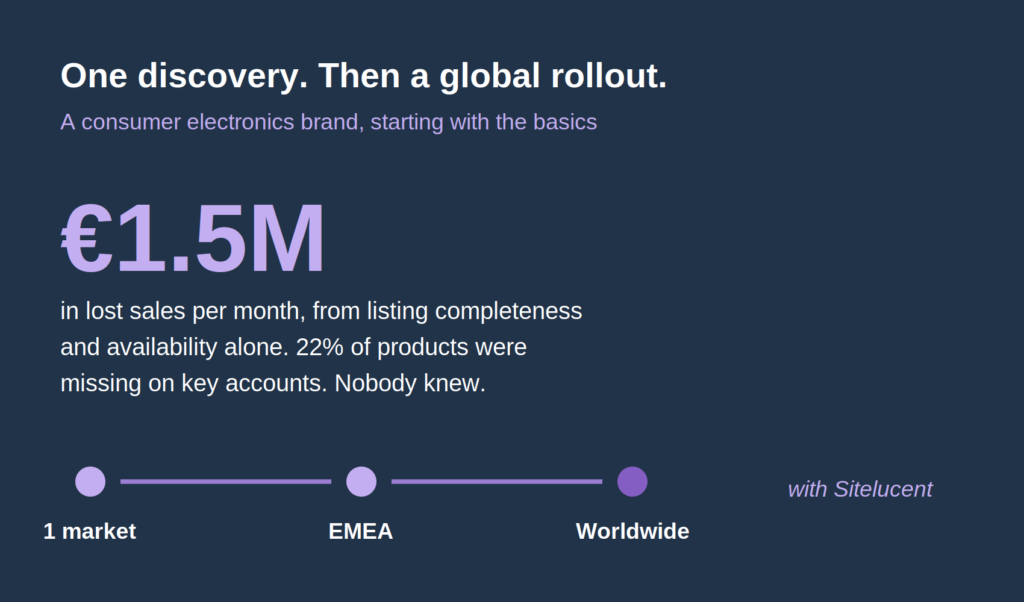
One consumer electronics brand came to us expecting to find a few gaps. Instead they discovered that 22 percent of their products were missing on key accounts. Nobody in the building knew. That was around €1.5 million in lost sales, per month, from listing completeness and availability alone. No new campaign, no pricing strategy, no content overhaul. Just products that weren’t where they were supposed to be, finally made visible.
That’s the pattern we see again and again. The first look at the shelf, through the consumer’s eyes, surfaces revenue that was quietly leaking with nobody watching. Closing those gaps recovers money that was already yours. It tends to pay for itself before anything else is even touched.
Then you build outward
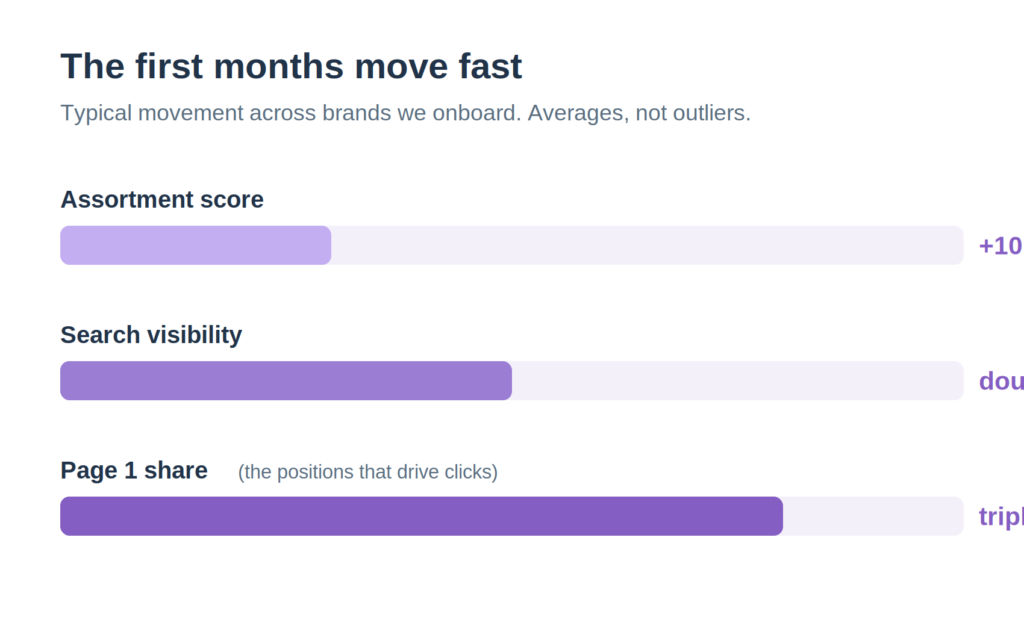
Once listings and availability are under control, the picture opens up. Each layer you add compounds the one before it. And the movement in those first months is often dramatic. Across the brands we onboard, we typically see:
→ Assortment scores climb 10 to 20 percentage points
→ Search visibility double
→ Page 1 share, the positions that actually drive clicks, triple
These are averages, not outliers.
From there, the compounding starts. Being listed is not the same as being found, so visibility and ranking come first: in a category where the buyer starts with a search, where you rank decides whether you’re in the running at all. Then content does its work. The electronics buyer is comparing specifications across several tabs at once, and complete, well-structured content is what converts them instead of sending them to a competitor with a clearer page. Better content lifts ranking, ranking lifts traffic, traffic meets better content. Each fix amplifies the next.
Pricing sits in here too. It’s volatile in electronics, moving by the minute on marketplaces where the Buy Box drives around 80 percent of sales and repricers adjust every ten to fifteen minutes. It deserves watching. But it’s one instrument in the set, not the whole score. Pricing seen in context, alongside availability, content and competitive position, is what makes it useful, rather than a number in isolation.
Then there are reviews, which carry unusual weight in this category. Nearly every buyer reads them, and when two products sit close on specifications and price, the rating is often what breaks the tie. Half a point higher can be the whole difference between the click and the competitor. Watching your reviews, and how they move against the competition, matters as much here as any spec. This is also where you see where rivals rank and where they’re gaining ground, and it’s the point where digital shelf work stops being maintenance and becomes strategy.
A year that concentrates into a few weeks
One more thing that makes electronics its own animal: seasonality. Close to 30 percent of annual sales fall into November and December.
That raises the stakes on every layer above. A stockout on a top product during a campaign week in November doesn’t cost an average week of revenue. It costs your best week, at the exact moment demand and competition peak. And because a stockout tends to carry an algorithmic penalty, recovery can eat into the very window that matters most.
The brands that handle Q4 well don’t treat it as something to survive. They use the months before it to make sure nothing breaks when it counts, which is exactly what continuous sight of the shelf is for.
Easy to find, easy to choose
Simon Swan, who leads digital growth and transformation at KARO Healthcare and works with Sitelucent, frames the whole thing in five words: easy to find, easy to choose.
That’s what all of this adds up to. Every layer, from listings to availability to visibility to content to reviews, exists to make your product easy to find when the consumer looks, and easy to choose when they compare. In a category as transparent and comparison-driven as electronics, those two things are the entire contest.
The consumer electronics brand that discovered €1.5 million a month with Sitelucent didn’t stop at one country. From a single market, to EMEA, to worldwide. That progression is the story in miniature: see the shelf clearly, fix the basics, then build outward until easy-to-find and easy-to-choose is true everywhere you sell.
The brands that stand out
Electronics is a category of constant comparison. Shoppers line products up side by side, on specification, on price, on rating, and choose. That’s a hard place to compete if you can’t see what the consumer sees. It’s a real advantage if you can.
The brands winning this category online aren’t necessarily the loudest or the cheapest. They’re the ones that are present, accurate and visible at every one of the hundreds of small moments where a shopper is comparing and deciding.
In a category this transparent, that consistency is the whole game.
What stands out, sells.