

Why digital shelf optimisation is becoming essential for the brands that once needed it least.
For a long time, luxury sat comfortably apart from the rest of retail. While FMCG brands fought for shelf space and electronics brands battled on price, luxury houses controlled the experience end to end. The boutique, the lighting, the service, the story. Scarcity was strategy, and control was absolute. That world is changing, and the brands that recognise it first will be the ones that come out ahead.
The ground is shifting under luxury
The numbers tell a sobering story. After years of seemingly unstoppable growth, the personal luxury goods market has stalled. Bain and Altagamma put the personal luxury goods market at around €358 billion in its most recent full-year study, down from €364 billion the year before, an erosion that signals maturity rather than renewed momentum. Bain & Company
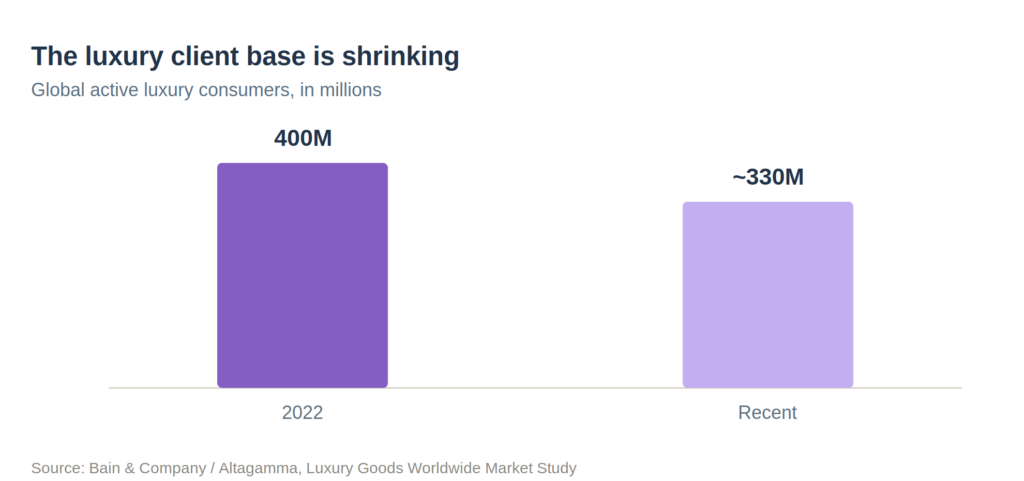
What’s happening underneath that topline matters more. The global luxury client base has shrunk to roughly 330 million, a decline of around 15% from 400 million in 2022, returning the market to its 2013 size. Only 40% to 45% of potential luxury consumers actually made a purchase last year, down sharply from 60% in 2022. Mission MediaMission Media
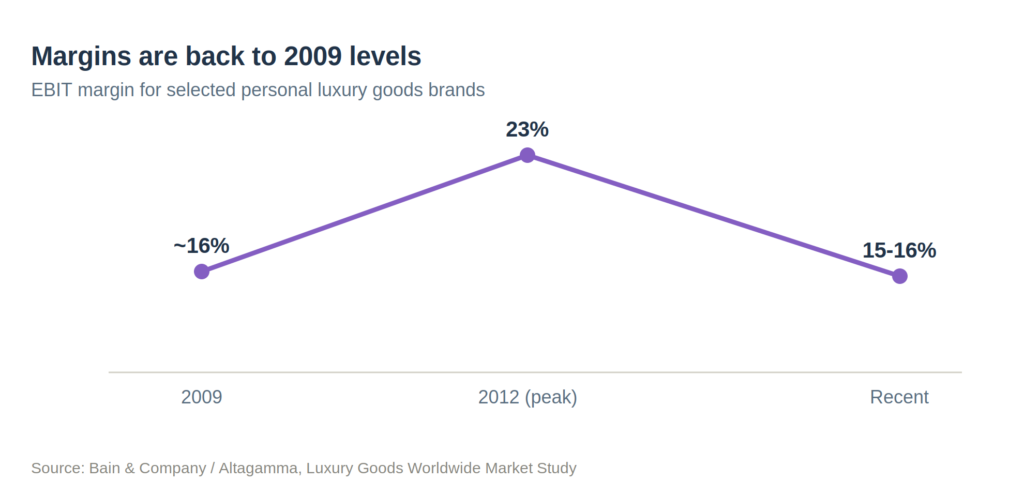
And the pressure shows up where it hurts most. EBIT margins for selected personal luxury goods brands, which peaked at 23% in 2012, have fallen to around 15–16%, similar to 2009 levels. Higher operating costs and the difficulty of sustaining revenue growth have wiped an estimated €100 billion from the industry’s enterprise value over the past year.
The era of automatic growth is over. Every euro of revenue now has to be worked for.
Where the growth still lives: online
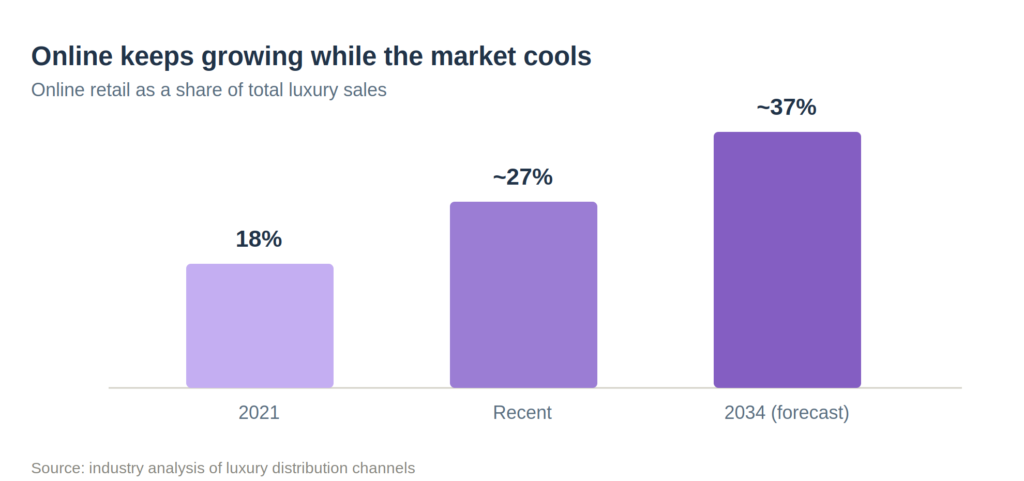
While the overall market cools, one channel keeps expanding. Online retail has grown from roughly 18% of luxury sales in 2021 to an estimated 27% recently, and is forecast to reach close to 37% by 2034. Major houses across LVMH, Kering, Richemont and Prada Group have substantially increased their investments in digital infrastructure and social commerce. DatainteloDataintelo
The reason is generational. The aspirational and younger buyers entering luxury are doing it online first. Brand-operated online stores have shown encouraging traction among aspirational clients, while multibrand platforms continue to struggle. For luxury brands, this is the paradox of the moment: the channel that’s growing is also the channel they control least. Bain & Company
The control problem nobody talks about
A luxury brand can spend a fortune perfecting its boutique experience, then watch that same product appear online with the wrong image, an incomplete description, an unauthorised seller, or a price that quietly undermines everything the brand stands for.
This happens more than most brands realise. An estimated 8% of the personal luxury goods market is grey, with genuine products flooding online marketplaces through unauthorised channels, diluting brand exclusivity and eroding perceived value.
The mechanics are brutally simple. A product appears on a marketplace through a seller the brand doesn’t recognise, at a price slightly below the official listing. The difference seems negligible at first. Then the marketplace algorithm reacts, one seller lowers the price, another matches it, a third discounts further to win the Buy Box. For a brand built on price integrity, that cascade is corrosive. And it happens silently, on shelves the brand never thinks to check.
The damage goes beyond price. Official listings can lose organic search visibility, unauthorised sellers can appear above the official brand in search results, and outdated or incorrect product descriptions spread across channels. The consumer searching for your product sees whatever the digital shelf happens to show them, which may have nothing to do with the brand world you built.
Why this is a luxury problem now
For years, luxury brands could treat the digital shelf as someone else’s concern. When online was 5% of sales and tightly controlled, the blind spots were small enough to ignore.
At nearly 27% and climbing, they aren’t anymore. Every percentage point that moves online is a percentage point where exclusivity and control, the brand’s most powerful assets, are hardest to enforce. And in a market that’s no longer growing on its own, the revenue leaking through those blind spots won’t be replaced by rising demand.
This is exactly why brands that historically held themselves apart from this conversation are now arriving at it. It reaches beyond fashion and leather goods. Premium home and living brands, where craftsmanship and price positioning matter just as much, have found their way to digital shelf optimisation too. When a high-end fixtures brand like Hansgrohe, or a premium Dutch kitchen brand like ATAG, takes control of how its products appear across retailers, it’s the same logic at work: a premium product deserves a premium presence, everywhere it’s sold.
What taking control actually means
Taking control of the online shelf doesn’t mean abandoning what makes luxury, luxury. It means extending that same discipline to the one place it’s been missing.
It means knowing, every day, whether your products are listed correctly across every retailer and marketplace. Whether your imagery is the imagery you approved. Whether your product descriptions reflect the brand or a reseller’s careless copy-paste. Whether your price is being respected or quietly undercut by a seller you’ve never heard of. Whether you’re visible when a consumer searches your category, or buried beneath competitors who optimised better.
It means seeing your competition clearly too. Where they’re winning visibility, where they’re priced, how their content compares to yours. For a category defined by positioning, knowing exactly where you stand against the brand next to you isn’t a luxury. It’s a necessity.
That is what a digital shelf analytics and optimisation platform delivers: a continuous, consumer’s-eye view of how your brand actually shows up online, with the alerts, the context and the priorities that let your team act before revenue leaks.
The opportunity inside the pressure
There’s a defensive version of this story: monitor the shelf, stop the leakage, protect the margin. That alone would justify the investment in a market where €100 billion in value has evaporated and margins have returned to 2009 levels.
The brands that pull ahead see further. A perfectly controlled digital shelf is also a growth engine.