

It’s the category where the customer researches online, trusts reviews above all, and often decides before they ever reach the store. Which makes the digital shelf decisive, even for what sells offline.
DIY and home improvement is a category built on confidence. A drill, a pressure washer, a tile cutter, a set of garden tools, a roll of wallpaper. These are purchases people expect to last, and get right the first time. Nobody wants to buy a Bosch drill that turns out to be underpowered for the job, or a Kärcher that can’t handle the patio, or a tool set that arrives missing half the promised pieces.
That need to get it right shapes how the whole category is bought. And increasingly, it’s shaped online.
The global DIY and home improvement market is worth around $0.87 trillion, and online now accounts for close to 30% of it, growing steadily every year. But the online share understates the real influence of the digital shelf, because in this category, the screen shapes the sale long before, and often instead of, the checkout. Let’s walk through why, and what taking control looks like.
The category where the decision is made online, wherever the sale lands
DIY has one defining trait that sets it apart: it’s the ultimate omnichannel category. The customer researches online, then buys online or walks into a B&Q, a Hornbach, a Home Depot, to pick it up. Either way, the decision is usually made on the digital shelf first. The numbers make the point:
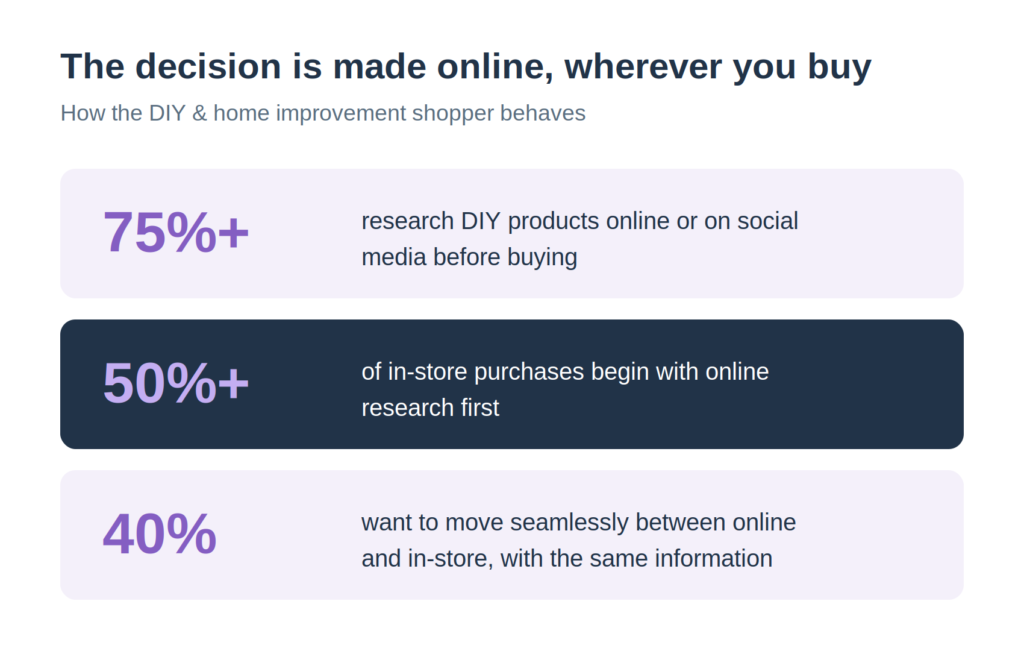
👉 More than 75% of shoppers research DIY and home improvement products online or on social media before buying
👉 More than half of in-store purchases begin with online research first
👉 Around 40% of homeowners want to move seamlessly between online and in-store, expecting the same information in both
Read that middle line again, because it’s the one most brands underestimate. Even the sale that happens in the store was very likely decided online. Your product page isn’t just competing for e-commerce revenue. It’s shaping whether someone walks into the aisle already looking for your brand, or your competitor’s.
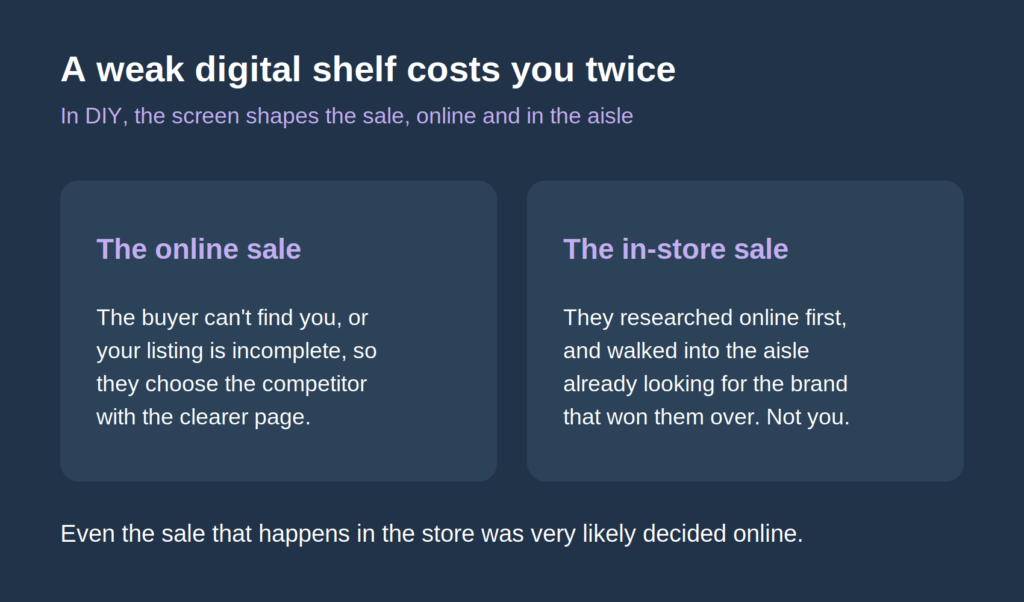
That means a weak digital shelf quietly costs you twice: the online sale you don’t convert, and the in-store sale you never influenced.
A category where reviews and content carry the whole decision
Here’s what makes DIY particularly unforgiving. The customer is buying on trust in performance, and they can’t test a drill’s torque or a pressure washer’s power through a screen. So they lean on the two things that can tell them: the content, and the reviews.
And they lean hard. In DIY, the review section is where the real evaluation happens. Shoppers read about whether the battery lasts, whether the motor overheats, whether the tool survives beyond the warranty. A study of the category found that most DIY shoppers always or sometimes read reviews before buying, and that over half would be more likely to purchase if richer content, video, and reviews were available.
The content itself has to carry an unusual load. A power tool listing lives or dies on the specifications: voltage, wattage, battery type, compatibility with a brand’s wider system. A DeWalt or Makita buyer already committed to one battery platform is filtering hard on compatibility. If your listing doesn’t make that clear, correct, and complete, the buyer moves on to the one that does.
And the barrier this creates is measurable. More than a third of homeowners abandon their online carts, and one of the leading reasons is difficulty evaluating product quality, exactly the gap that strong content and visible reviews are meant to close.
It starts with the basics: are you even there?
Before content and reviews, though, there’s a more fundamental question that catches brands out across every category we work in, and DIY is no exception. Is your product actually listed, in stock, and correct, everywhere it should be?
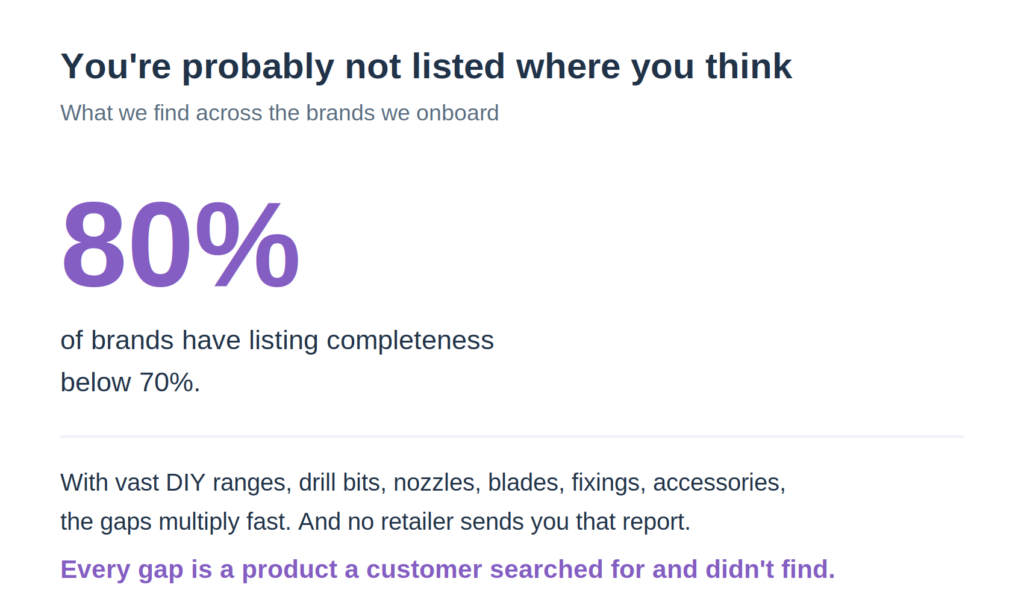
It sounds obvious. It rarely is. Across the brands we onboard, around 80% have listing completeness below 70%. Their products simply aren’t present everywhere they think they are, and no retailer sends you that report. In a category with vast ranges, think of the sheer number of drill bits, nozzles, blades, fixings, and accessories a single brand carries, the gaps multiply fast, and each one is a product a customer searched for and didn’t find.
This is where the digital shelf needs its own view. Your internal systems tell you what should be on the shelf. Your PIM says the content is complete, your plan says you’re listed at that retailer. But the customer doesn’t see your PIM. They see the retailer page, or the empty search result where your product should have been. The only way to know what’s really there is to look the way the customer looks, on the actual shelf, every day.
Then you build outward
Once listings and availability are under control, the picture opens up, and each layer compounds the one before it:
👉 Visibility and ranking, so the customer finds you in the retailer search where DIY discovery so often starts
👉 Content and specifications, complete and correct, so the performance-focused buyer can evaluate you with confidence
👉 Reviews, watched and benchmarked against the alternatives, in a category where they carry the decision
👉 Pricing, seen in context across retailers, so you hold your position without racing to the bottom
👉 Competitive positioning, so you can see where rivals rank, how their content compares, and where they’re winning
That progression turns the digital shelf from something you occasionally check into something that actively drives growth. Not a report you read after the fact, but a continuous, consumer’s-eye view of how your brand actually shows up, with the priorities that let your team act before revenue leaks.
Two kinds of win
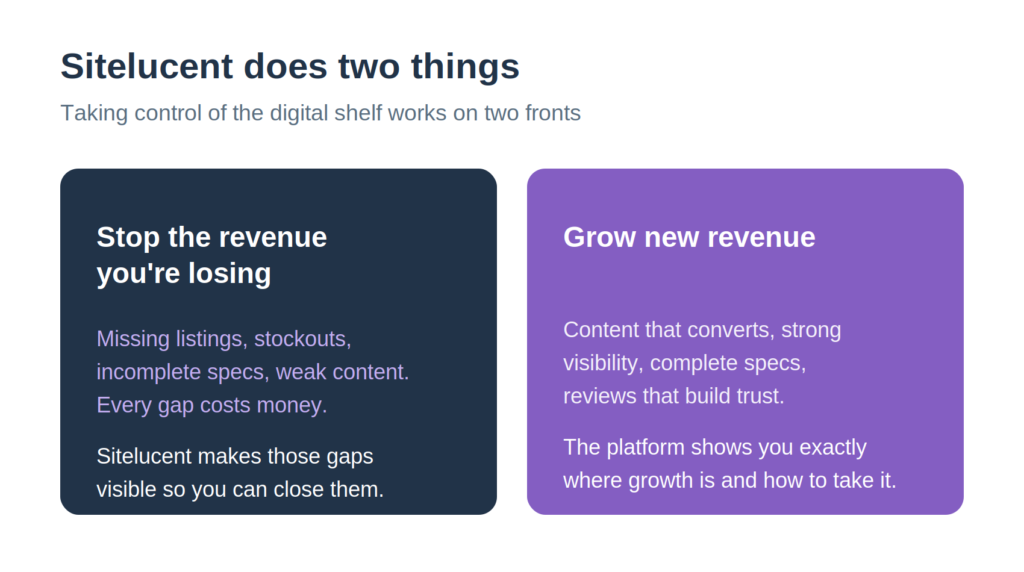
Taking control of the DIY digital shelf works on two fronts, and both are wins.
First, you stop the revenue you’re losing. Missing listings, stockouts, incomplete specs, weak content: every gap quietly costs money, both the online sale and the in-store sale it would have influenced. Making those gaps visible is what lets you close them, and recover revenue that was already yours.
Then you grow new revenue. Complete, accurate content converts the research-driven buyer. Strong visibility captures them in the retailer search where they start. Solid reviews and clear specifications win the trust the category runs on. And a clear view of the competition lets you win the comparison that decides the sale, online and in the aisle.
For a category where the customer researches this carefully, trusts reviews this much, and needs to get the purchase right, the digital shelf is where confidence is built or lost. The brands that treat it that way don’t just protect their revenue. They grow it, on every channel they sell through.
Sitelucent. What stands out, sells.