


It’s the category where the buyer hesitates longest, converts least, and needs the most convincing. Which makes the digital shelf the place where the sale is really made.
Premium home and living is a broad world. Kitchens and bathrooms, furniture and lighting, cookware and finishes. A Quooker tap, a Hotbath fixture, a Creuset pan, a sofa, a tin of quality paint. Different products, but they share three things that matter enormously online.
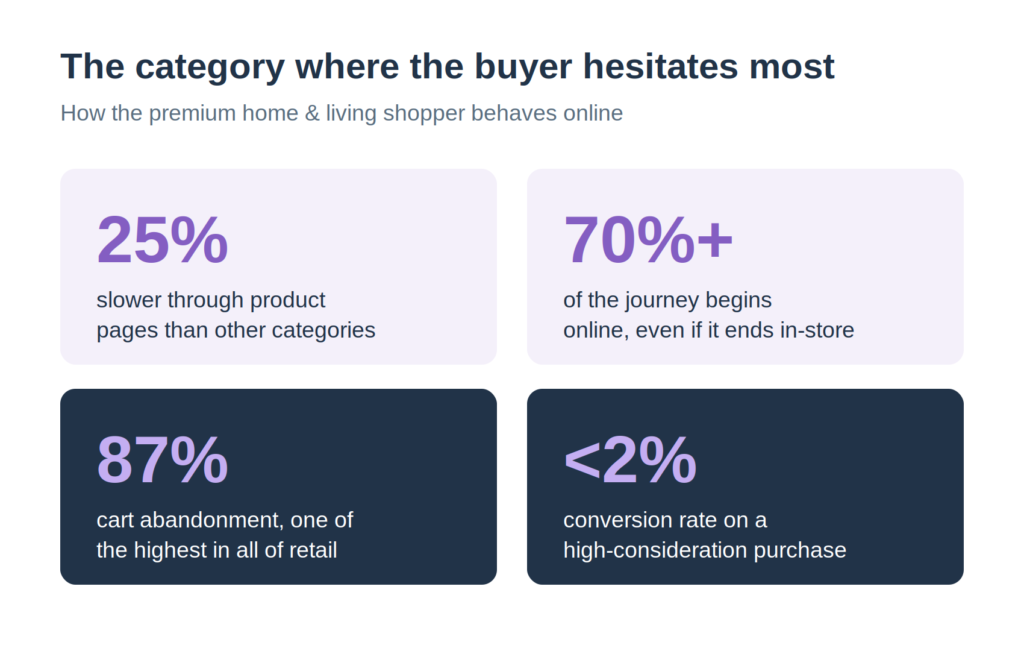
The category where the buyer hesitates the most
Home and living buyers behave unlike buyers anywhere else. They take their time, they compare, and they hesitate before committing real money to something they can’t touch. That shows up clearly in the numbers:
👉 Shoppers move through home and decor product pages around 25% slower than in other categories
👉 More than 70% of the furniture purchase journey now begins online, even when the sale ends in a store
👉 Furniture has one of the highest cart abandonment rates in all of retail, around 87%
👉 Conversion rates often sit below 2%
The screen is where the shortlist is built, where the comparison happens, and where the decision effectively gets made. The buyer can’t feel the fabric, test the weight of the pan, or see how the colour sits in their own room. That uncertainty is the single biggest barrier to purchase.
Every one of those hesitations happens on the digital shelf. Which means the shelf is where they’re either resolved or lost.
Why content and imagery carry more weight here than almost anywhere
When a buyer can’t touch the product, the content has to do the work the showroom once did. And the data is unambiguous about how much this matters:
👉 78% of shoppers say product images and descriptions are extremely or very important to completing a purchase
👉 Missing or low-quality visuals are a primary driver of cart abandonment and returns
👉 In furniture, unclear imagery and vague dimensions are among the most common reasons a buyer walks away, or buys and sends it back
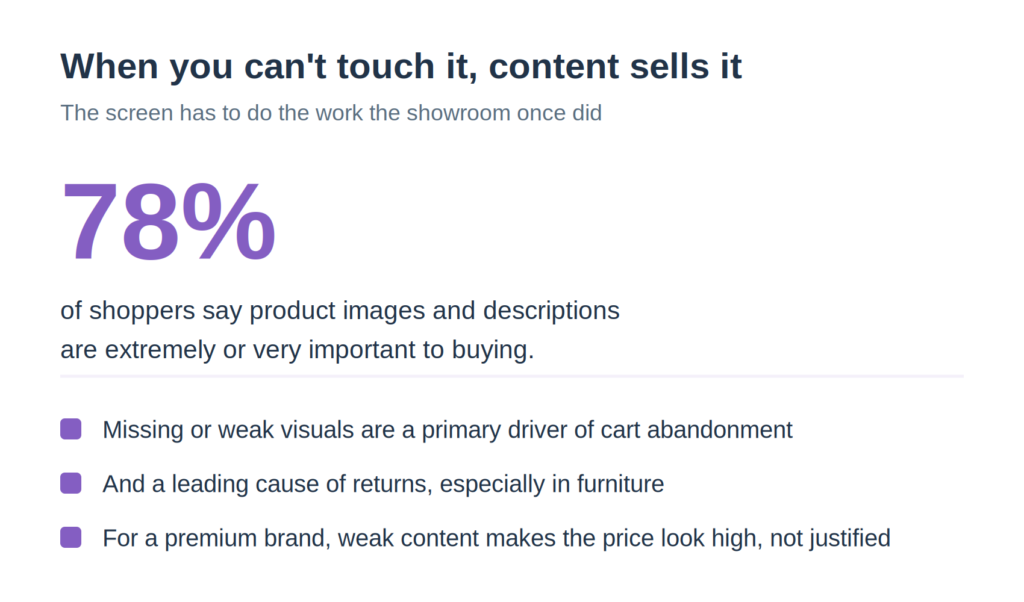
For a premium brand, this cuts deeper. Your product sits on a retailer page next to cheaper alternatives. If your content is incomplete, your images sparse, your specifications missing, the consumer has no way to see why your product costs more. The premium justifies itself through presentation, and when the presentation is missing, the price just looks high.
This is exactly the point Hotbath, a premium bathroom brand and Sitelucent customer, makes about its own category. As their team puts it, a premium product can otherwise sit next to budget alternatives without the content to justify the price. On the digital shelf, quality has to be visible to count.
The white space nobody sees
Before content and imagery, though, there’s an even more basic issue, and it’s where many home and living brands find their first and biggest win.
Are your products even listed where they should be?
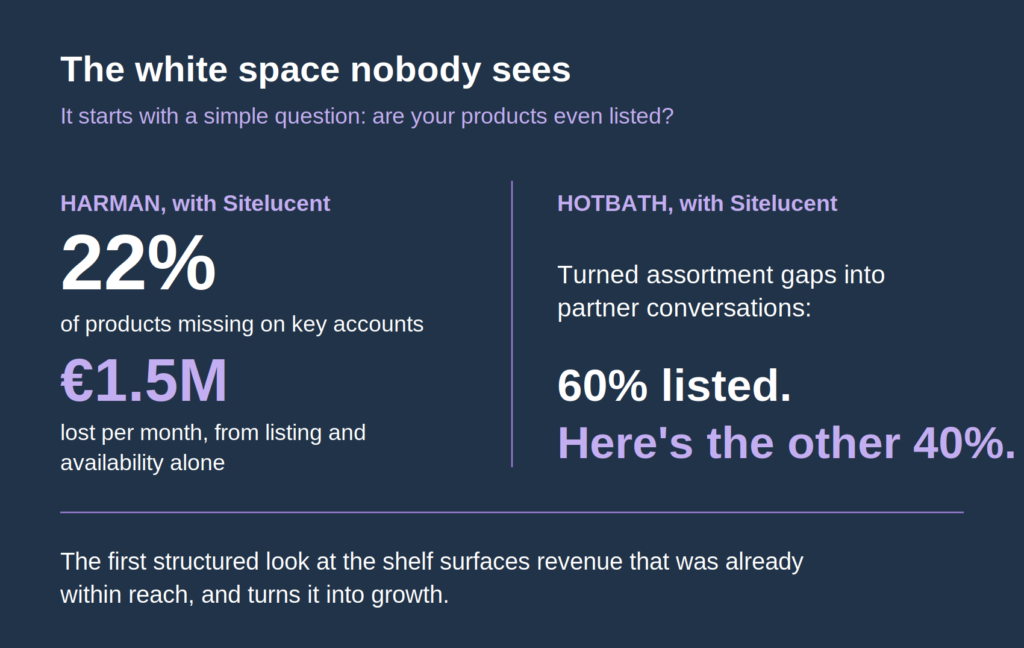
It sounds too simple to matter. It isn’t. Take a brief step into the consumer electronics world for a moment, because the clearest illustration comes from there. When Harman first looked at its shelf through the consumer’s eyes with Sitelucent, the team discovered that 22 percent of its products were missing on key accounts. That added up to around €1.5 million in lost sales per month, from listing completeness and availability alone, two of the most basic layers of digital shelf analytics. Nobody in the building had known. The products people assumed were on the shelf simply weren’t there.
Recovering that revenue was only the start. From there Harman scaled up across every other layer, content, visibility, competitive positioning, and the gains kept compounding. With progress like that, it’s no surprise the partnership grew the same way: from a single market to working with Sitelucent worldwide.
Back to home and living, because the same blind spot exists here, and Hotbath turned it into an advantage. Hotbath designs premium bathroom fixtures, but online its products sit on retailer pages it doesn’t control. Content, assortment, and category positioning vary from partner to partner, and none of it is visible from inside the brand’s own systems. Using Sitelucent, the most valuable discovery the team made was what they call white spots: gaps in assortment at partners where products should be listed but aren’t.
The shift that created is commercial, not just operational. Instead of spotting a gap by accident, Hotbath now walks into partner meetings with data. You’re listing 60 percent of our range, here’s the other 40 percent, and here’s the revenue potential in it.
In the words of Bram Vennemans, E-Commerce Account Manager at Hotbath: “Sitelucent has become essential for us in discovering white spots at our customers. It gives us direct insight into where our assortment isn’t being fully utilised, allowing us to proactively engage with our partners to capitalise on opportunities.”
That’s a pattern we see across premium home and living brands. The first structured look at the shelf surfaces listings that were quietly missing, and turns them into conversations that drive revenue.
Then you build outward
Once you can see where you’re listed and where you’re not, the picture opens up, and each layer compounds the one before it.
Category positioning comes next. Being listed isn’t the same as being found. Knowing where your products actually rank in a retailer’s category tells you where to improve content and findability, so the buyer discovers you at all. Then the content itself: complete specifications, rich imagery, the dimensions and materials and context shots that a high-consideration buyer needs to feel confident. This is where a premium brand earns its price on the screen.
Reviews carry unusual weight in this category too. For a high-value purchase, a product with no reviews often isn’t even considered, and a product with poor ones is quickly dismissed. Watching your ratings, and how they compare to the alternatives on the same shelf, matters as much as any specification.
And then the wider view: how you stand against the competition, where they rank, how their content and pricing compare. For a premium brand whose entire proposition rests on being visibly better, that competitive clarity is where digital shelf work turns from maintenance into strategy.
Two kinds of win
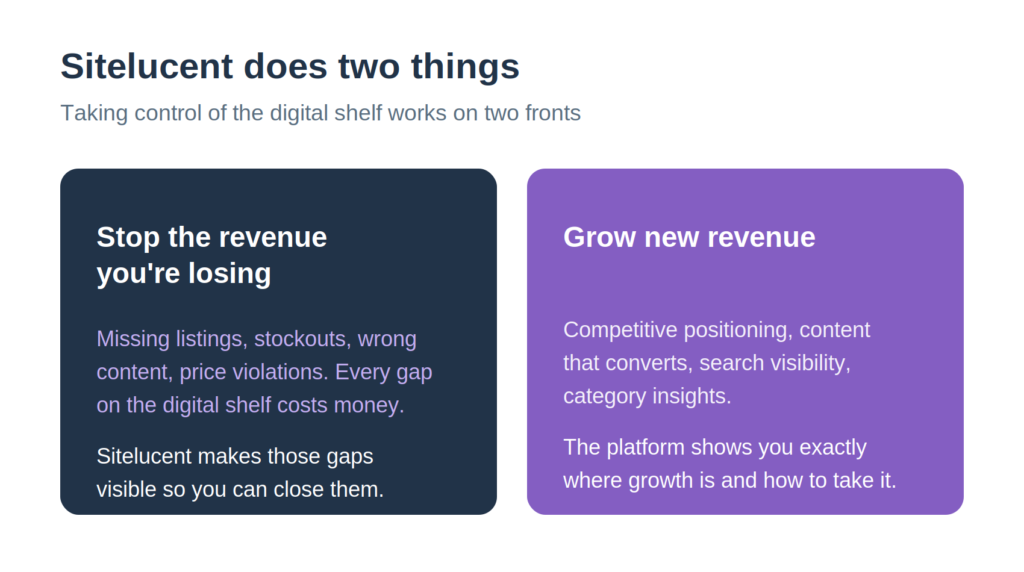
Taking control of the home and living digital shelf delivers two things, and both are wins.
First, you stop the leak. Missing listings, weak content, poor visibility, all of it quietly costs revenue that was already within reach. Closing those gaps recovers money that was yours to begin with, and as the Hotbath example shows, it often pays for itself in the partner conversations it enables.
Then you create new revenue. Complete, confident content converts the hesitant buyer who would otherwise abandon. Strong positioning captures them at the top of a journey that starts online. Visible quality justifies the premium. And clear sight of the competition lets you win the comparison that decides the sale.
For a category built on craftsmanship and made to be seen, the digital shelf is simply the newest room where the product has to look its best. The brands that treat it that way don’t just protect their revenue. They grow it.
What stands out, sells.