

In a category where the consumer researches obsessively, trusts reviews above all, and buys on claims that have to be exactly right, the digital shelf is where the brand is made or lost.
Health and personal care has quietly become one of the most digital categories in retail. Skincare, haircare, oral care, personal hygiene, over-the-counter health. Products people use every day, increasingly discovered, compared, and bought online.
The global beauty and personal care market is worth well over $600 billion, and online now accounts for around a quarter of it, on its way to roughly a third by 2030. More telling than the size is the direction: e-commerce is growing several times faster than traditional retail in this category. The shelf that matters most is increasingly the digital one.
And it’s a shelf the brand doesn’t fully control. Your products sit on retailer pages, in retailer search results, next to competitors, presented in ways your own systems can’t see. What matters is not what your internal tools say is happening, but what the consumer actually sees when they look. That gap between the two is where revenue quietly leaks. Let’s walk through why this category makes the gap so costly, and what taking control looks like.
The most researched, most review-driven purchase in retail
Few categories are researched as heavily as health and personal care. The consumer reads, compares, and cross-checks before committing, and above all, they read reviews. The numbers make the point:
👉 More than 6 in 10 shoppers say they always read reviews before buying beauty and personal care products online, and another third read them sometimes
👉 Positive ratings and reviews rank among the top factors driving conversion, just behind price and quality
👉 Around a third of consumers use retailer site search results to discover products they’ve never bought before, and trust those results when deciding
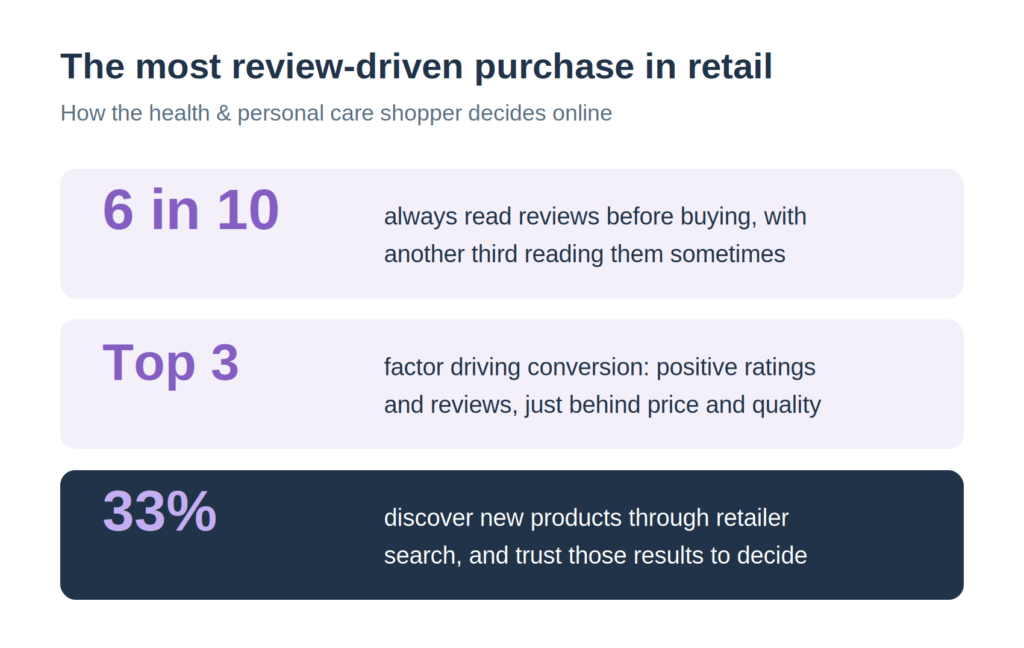
That last point matters more than it looks. The buyer often doesn’t arrive at your product page directly. They land on a retailer homepage, type a search, and choose from what comes back. If you’re not visible in those results, you’re not in the running, no matter how good the product is.
A category where the content has to be exactly right
Health and personal care carries a burden most categories don’t: the claims have to be correct, and the trust signals have to be there. A skincare buyer cross-references reviews, ingredient lists, secondary images, and clinical or usage information before adding to cart. In a claims-sensitive category, that’s usually where conversion breaks or holds.
Yet a striking number of product pages fall short. Analysis of hundreds of thousands of beauty and personal care pages found many carrying just a single image and a handful of bullet points, far less than a research-driven buyer needs to feel confident. For a category this scrutinised, incomplete content isn’t a minor gap. It’s the difference between a conversion and a bounce.
For a brand, this creates two problems at once. Incomplete or inconsistent content quietly suppresses conversion on the traffic you already have. And because so much of the category runs on paid media, every weak page is also wasting advertising spend.
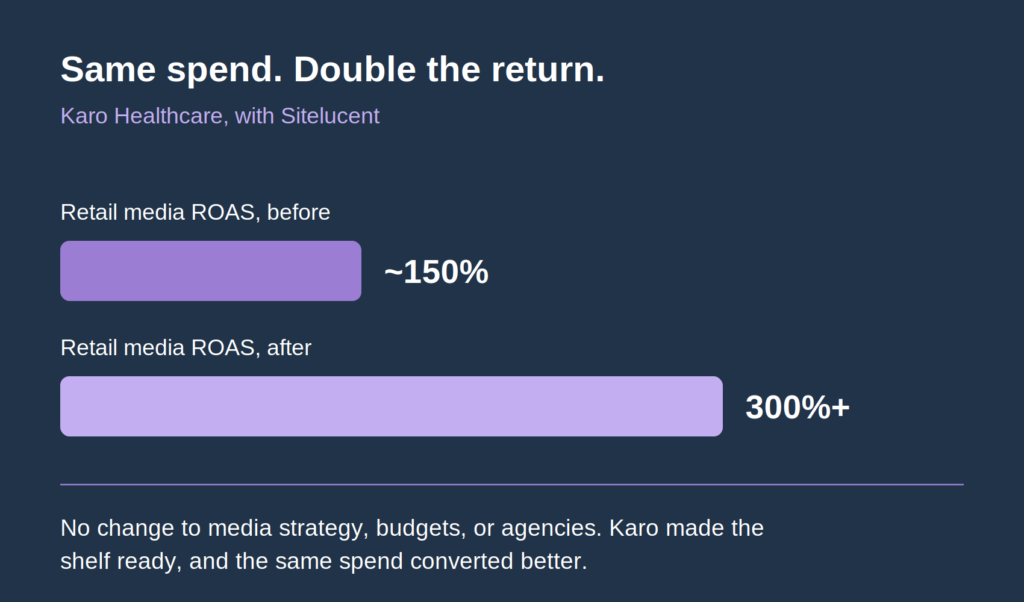
That second point is where one of our clients found a striking result. Karo Healthcare was measuring its retail media performance, but not the quality of the pages that traffic was landing on. A campaign can send thousands of clicks to a page, but if the content is incomplete, those clicks don’t convert. Karo used Sitelucent to make sure every page receiving paid traffic met a baseline standard: complete content, consistent images, live listings, accurate information.
The effect showed up directly in the numbers. On comparable media spend, one brand’s return on ad spend more than doubled, from around 150% to over 300%. As Simon Swan, Digital Growth & Transformation Leader at Karo Healthcare, puts it, the platform is configured around two questions: easy to find, and easy to choose. Karo changed no media strategy, no budgets, no agencies. It made the shelf ready, and the same spend converted better.
It starts with the basics: are you even there, and at the right price?
Before content and conversion, though, there are two more basic questions that catch brands out. Is your product actually listed and in stock where it should be? And is the price holding where it should?
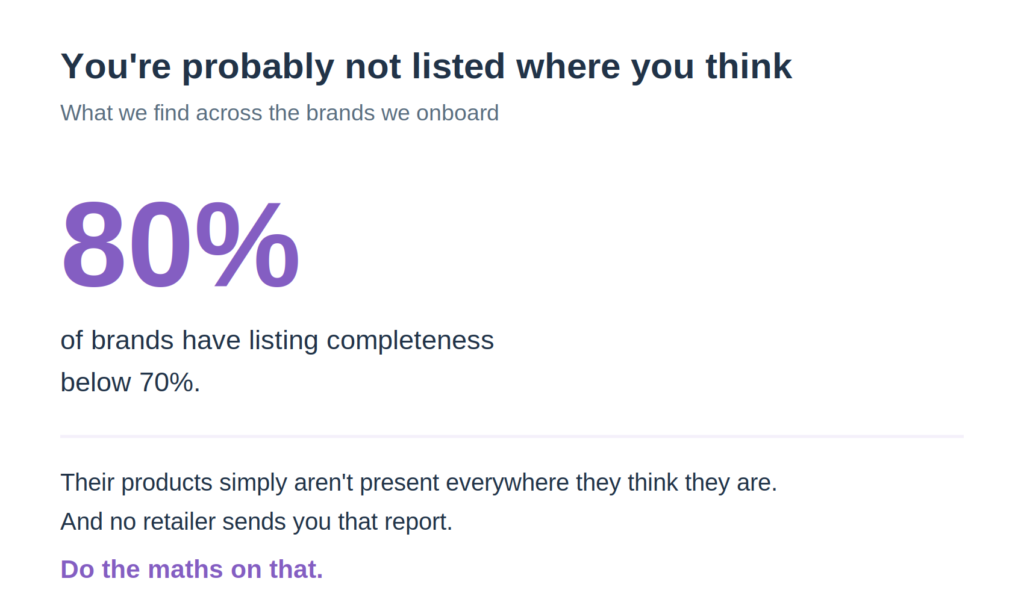
Here’s the uncomfortable part. Most brands assume they’re listed where they expect to be. The reality is often different: across the brands we onboard, around 80% have listing completeness below 70%. Their products simply aren’t present everywhere they think they are. And no retailer sends you that report. Do the maths on that, across every SKU and every account, and the scale of the quiet revenue loss becomes clear.
This is the heart of why the digital shelf needs its own view. Your internal systems tell you what should be happening. Your PIM says the content is complete, your ERP says the product is in stock, your plan says you’re listed on that retailer. But the consumer doesn’t see your PIM. They see the retailer page. And the only way to know what’s really there is to look the way the consumer looks, on the actual shelf, every day.
Take pricing. Medela Europe works with a pricing corridor: a recommended selling price at the top, a lowest promo price at the bottom. Monitoring it by hand across markets and currencies meant covering only a handful of SKUs in a spreadsheet, with no cross-country view and no alerts.
The hard part was never spotting a price drop. It was knowing what it meant. A price below threshold could be a brand-funded promotion, a retailer discounting at its own expense, competitive pressure, or the start of margin erosion, and there was no way to tell them apart, or to push back when a retailer asked for lower purchasing prices. With Sitelucent, Medela now sees deviations immediately, in context, across the full portfolio, and walks into retailer negotiations with the data: what was promoted, when, the impact, and whose decision it was.
The same clarity applies to listings and availability, which is where many brands find their very first win. Continuous, SKU-level monitoring answers a simple question that internal systems can’t: is the product live, in stock, and correct on every retailer, right now, as the consumer sees it?
BaByliss Benelux felt this shift directly. Before Sitelucent, the team relied on manual checks, spreadsheets, and internal reports that showed what should be happening, not what was. Stockouts surfaced late, and there was no structured view of content quality across retailers. With continuous monitoring in place, gaps that used to go unnoticed for days now surface in real time. As Leslie Castillo, Senior Business Analyst Benelux at BaByliss, put it, the team finally works from one version of the truth, and marketing and sales look at the same data.
Then you build outward
Once listings, availability, and pricing are under control, the picture opens up, and each layer compounds the one before it:
👉 Visibility and ranking, so the buyer finds you in the retailer search results where discovery happens
👉 Content and trust signals, so the page converts the research-heavy, review-driven shopper
👉 Reviews, watched and benchmarked against the alternatives, in a category where they often decide the sale
👉 Competitive positioning, so you can see where rivals rank, how their content compares, and where they’re gaining
That progression is what BaByliss describes as moving from catching problems to improving performance: better content and consistency, faster fixes on weak pages, decisions based on data rather than opinion. A steady stream of small corrections that feeds directly into measurable revenue growth.
Two kinds of win
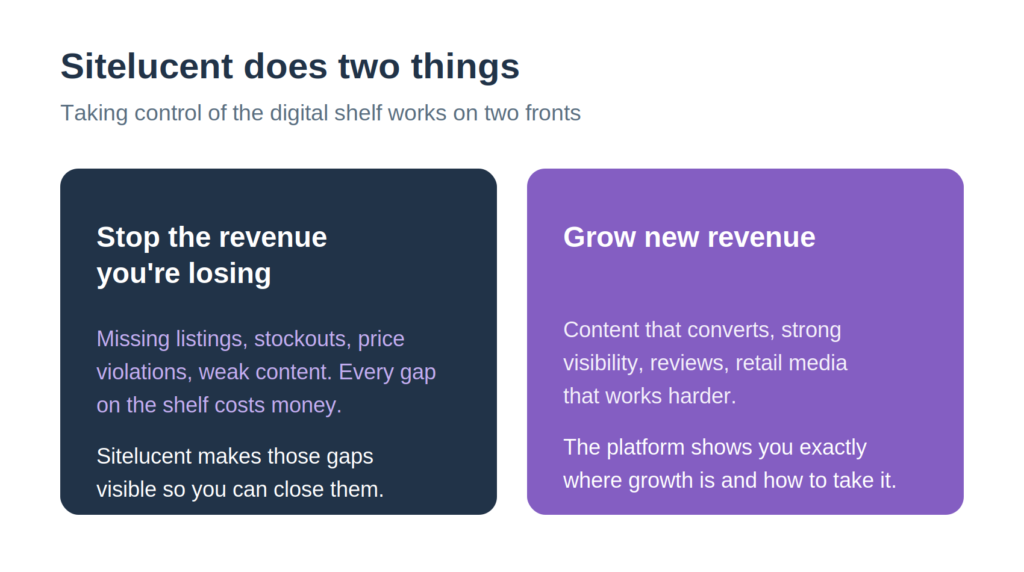
Taking control of the health and personal care digital shelf works on two fronts, and both are wins.
First, you stop the revenue you’re losing. Missing listings, stockouts, price violations, weak content: every gap on the digital shelf quietly costs money. Making those gaps visible is what lets you close them, and recover revenue that was already yours.
Then you grow new revenue. Complete, accurate content converts the research-driven buyer. Strong visibility captures them in the retailer search where they start. Retail media works harder when the pages behind it are ready. And clear sight of reviews and competitors lets you win the comparison that decides the sale.
For a category where the consumer researches this hard, trusts reviews this much, and needs the claims to be exactly right, the digital shelf is where it all comes together. The brands that treat it that way don’t just protect their revenue. They grow it.
Sitelucent. What stands out, sells.